
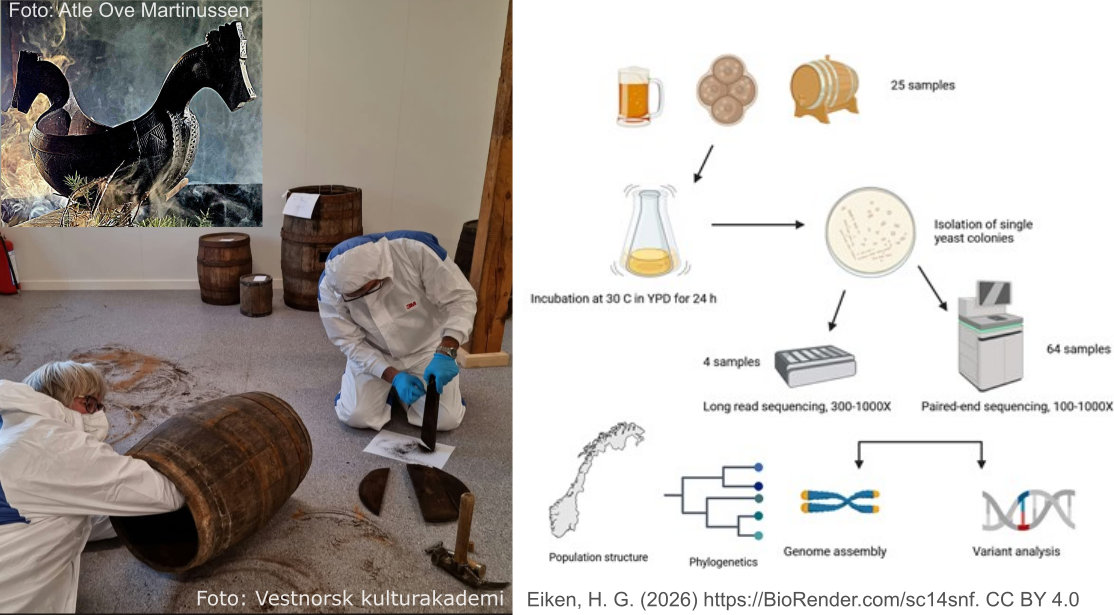
Farmhouse brewers in western Norway have kept a living yeast culture, called kveik, at home for centuries. They dry it and store it between brews, then repitch it for the next batch of beer and pass it down through generations. The obligation to brew is documented in the Older Gulating Law, one of Norway’s oldest legal texts, written down in the Middle Ages. It likely continues a much older, pre-Christian tradition of brewing for the midwinter feast. A recent study on kveik in Genome Biology and Evolution has been carried out in an international collaboration between NIBIO, Vestnorsk Kulturakademi, the University of Bergen, and the University of Copenhagen with substantial support from ELIXIR Norway. It shows that the intangible cultural heritage of farmhouse brewing has uniquely preserved its microbial key player.
The researchers analysed 64 yeast samples from 25 traditional brewing cultures, chosen for their documented histories. Nearly all industrial brewing yeasts trace back to single-cell isolations made in laboratories since the 1880s. Kveik cultures are remarkably different: they have been passed down over generations by the families who inherited them, and their genomes reflect it. Genetic analyses show that kveik cultures descend from ancestral populations that date back at least 1,000 years.
The study also changes how we interpret the origin of kveik. Earlier studies reported that kveik may show signals of admixture from Asian fermentation lineages. The new analyses show that these signals were likely a statistical artifact. The link to Asia, where domesticated brewer’s yeasts originate, is much older, carried over from the ancestral population onto a branch that split off early.
Elsewhere in the Nordic countries, ancient brewing traditions have been discontinued or the local strains have disappeared. In Norway, the cultural heritage and the organism have survived together, and neither can be safeguarded without the other.
Read the full study in Genome Biology and Evolution.